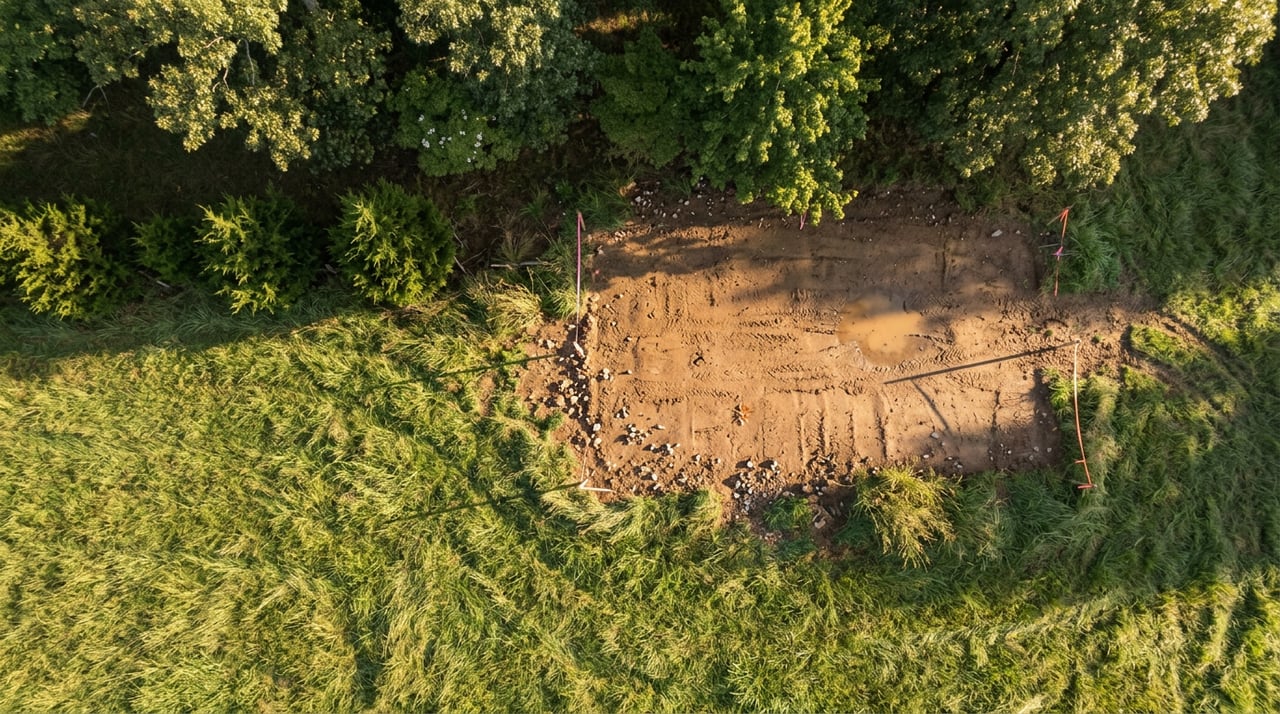
Why Two Chester County Land Listings at the Same Price Per Acre Aren't the Same Deal
August 27, 2026
August 27, 2026
Picture two buyers scrolling the same land listings on the same afternoon. One is eyeing a small parcel just outside Henderson, priced to work out to roughly $10,000 an acre. The other has a bookmark open for a stretch of hunting ground on Sand Mountain Road, running closer to $3,000 an acre. Both assume the cheaper tract is the better deal. Neither has asked the one question that actually determines what they're buying: has anyone confirmed this ground can support a house.
That question, more than location or acreage, is what separates a buildable Chester County lot from a long-term holding cost. And it's the reason the county's own per-acre numbers contradict each other depending on which slice of the market you're looking at.
Pull two different land-market trackers for Chester County and you'll get two different stories. One shows a median price of roughly $4,909 an acre, built mostly from the large hunting, timber, and recreational tracts that dominate the county's rural southwest, places like the ridgeline parcels off Sand Mountain Road or the rolling ground near Silerton on Highway 125. Another shows an average closer to $10,567 an acre, pulled up by smaller parcels, the kind sized for a single homesite rather than a deer lease.
Neither number is wrong. They're measuring different populations of land. A 175-acre timber tract and a 1.3-acre lot in a platted subdivision are not competing for the same buyer, and averaging them together (or pulling them apart) will always produce a different headline. The mistake buyers make is treating "price per acre" as a single, portable metric they can carry from listing to listing. In Chester County, it isn't. It's a function of what the tract is for, how much of it is usable, and whether the hardest part of buying rural land here has already been done.
That hardest part is the soil.
Tennessee law is specific about the order of operations, and it runs opposite to how a lot of buyers think about the process. You don't buy the land, pick a builder, and then find out where the septic system goes. The soil evaluation has to happen first, because it determines whether a system can go there at all, and what kind.
State code lets a landowner submit either a percolation test or a high intensity soils evaluation performed by a soil scientist certified by the Tennessee Department of Environment and Conservation. In practice, most sellers and buyers go the soil-scientist route: a certified evaluator maps the soil types on the parcel and reports a rating, expressed in minutes per inch, that measures how quickly the ground absorbs water. Soil that drains well can usually support a standard tank-and-drainfield system, the cheapest option to install and maintain. Soil that drains poorly doesn't automatically kill the deal, but it pushes the design toward something more expensive: a larger or shallower field, a drip dispersal system, or an aerobic treatment unit that processes wastewater before it reaches the ground.
None of that gets decided by a builder or a real estate agent. It gets decided by whoever signs off on the soil map, and that signoff has to happen before the Chester County Health Department in Henderson will issue a septic construction permit. If you're buying land that already has a filed soil map or an existing home with a working system, you skip most of this. Tennessee doesn't require a new perc test for a house that already has septic. Your due diligence shifts to a different question: how old is the system, when was it last pumped, and does its condition match what the listing implies.
If you're buying raw, unimproved acreage, the soil work is the real gate. A cheap per-acre price on land that hasn't been evaluated isn't a discount. It's a price with an unresolved variable in it.
Assume the soil clears and the septic permit is in hand. There's still a building permit to secure, and Chester County's threshold catches people off guard because it's lower than they expect.
The county requires a permit for any construction valued at $2,000 or more. That's not just the house. It covers additions, decks, porches, carports, swimming pools, and accessory buildings, whether purchased prefabricated or built on site, and it applies to mobile and manufactured homes as well. Building without one isn't a paperwork slap on the wrist, it's a Class C misdemeanor under the county's code, and inspectors, appraisers, and title companies routinely check for unpermitted structures during a later sale.
There's a second layer buyers on the edge of Henderson need to know about. The area immediately surrounding the city, what the county calls its planning region, is permitted and enforced by the City of Henderson's Building and Zoning Department rather than the county office. Everything outside that ring falls to the Chester County Building and Zoning Department at 159 East Main Street. The two offices largely mirror each other on fees and requirements, but they are not the same phone call, and a parcel that looks purely rural on a map can still sit inside the city's planning jurisdiction. The county last updated its permit requirements in 2021, adopting the 2018 International Residential Code, and state rules require another update roughly every seven years, so the next code revision is on the horizon later this decade. None of that changes what a buyer needs to do today, but it's worth knowing the baseline you're building against isn't frozen in place.
Once you know what sits underneath the per-acre number, the listings start to sort themselves differently. A large hunting or timber tract, the kind that makes up a meaningful share of what's currently on the market in Chester County's southwest corner, is priced for its recreational and long-term timber value. Nobody is running soil evaluations on 150 acres of pine plantation before listing it, because the buyer isn't planning to build there next year. That's a large part of why those tracts pull the county's median per-acre price down.
A smaller parcel marketed with language like "survey, soil map, and perc tested" or positioned along a corridor like US Highway 45 near Henderson is priced for a buyer who wants to build soon, and the seller has often already absorbed the cost and delay of the soil work. That's not padding. It's the seller having already cleared the gate that would otherwise sit between you and a building permit.
Here's how the two ends of the market tend to compare:
| What's being priced | Typical acreage | Soil work usually done | Per-acre range |
|---|---|---|---|
| Hunting, timber, and recreational tracts | 60 to 200+ acres | Rarely, buyer's responsibility | Lower end of the range |
| Small residential-ready parcels near town | 1 to 20 acres | Often already filed | Higher end of the range |
If you're comparing two listings and one looks like a bargain per acre, ask directly whether a soil map or perc test has been filed with the county, and ask which building department, city or county, has jurisdiction over that address. Those two answers will tell you more about the real cost of building there than the sticker price per acre ever will.
Roughly half of Chester County's land base is still in active farm use, corn, soybeans, and wheat mostly, on soils that support steady row-crop yields. That agricultural character is part of why the county's land market behaves the way it does: a lot of what's for sale was never evaluated for a house because it was never meant to hold one. Buyers who understand that distinction stop comparing apples to timber stands.
Do I need a new perc test if the land already has a house on it? No. An existing system was already permitted against an evaluation. Your focus shifts to the system's condition, including tank age and pumping history, rather than the soil itself.
Who do I call first, the city or the county? It depends on the address. Property inside Henderson's planning region, the area surrounding the city limits, is handled by the City of Henderson Building and Zoning Department. Everything else goes through the Chester County Building and Zoning Department on East Main Street. Confirm jurisdiction before you assume either office is the right one.
What happens if I build without a permit in Chester County? It's a Class C misdemeanor under county code, and it tends to surface later, during a title search, an appraisal, or a buyer's inspection when you go to sell.
Does a failing perc test mean the land can't be built on? Not necessarily. Marginal soil usually means a different, more expensive system design rather than a dead deal. But it's a cost worth knowing before you're under contract, not after.
If you're comparing acreage in Chester County and want someone to walk the soil-and-permit sequence with you before you write an offer, Stellar Realty Group works with land buyers, builders, and hobby-farm owners across the county every week. Call or message Destiny Burns for a straight read on what a specific parcel will actually cost to make buildable, not just what it costs to buy.
Stay up to date on the latest real estate trends.

We'd love to hear from you! Whether you're buying, selling, or just exploring your options, we're here to provide answers, insights, and the support you need. Contact us and start planning your next move.